Showing posts with label Studio Flash. Show all posts

Tuesday, February 25, 2014

Profoto Sun And Moon Lighting Special Offer


Don't say we aren't poetic around here. The sun and moon referred to in the title describes the special offer we have on right now of four single light plus reflector kits. The wonderful news is that they are Profoto kits.

If you are just starting out in studio photography but wish to commence with the best - to start building up a professional lighting outfit that will not be outpaced later in your career - this is your chance. We have for Profoto D1 heads on big sturdy LS-2 light stands for your main light, and a Profoto white/gold 32" reflector for the fill. This is the reflector so inexpertly handled in yesterday's post by the old guy. It is a very good reflector...

The D1 is the basis for all of Profoto's light shaping system - the attachments do not vary. It s triggered by standard synch cord, though later on you may wish to get one of their radio synch sets if you add more lights to the studio. The output is consistent, controllable, and convenient. The mounting structure of Profoto heads is superb - professional all the way and built for decades of daily use.

The Promaster LS-2 stand is large and tough and can go up to 2.8 metres. Plenty of height for a down light. Like the sun.

Four photographers will benefit from this offer, as there are four sets on offer. They normally have a price of $ 1342.........this is reduced to $ 1099 for these four sets.

Hop in for your chop pretty quick. The sun and moon will only be here a short time...


Thursday, February 20, 2014

Sand Bags, Shot Bags, And Tea Bags


I bags being in the next photo shoot!

This whole Friday morning footle came about when one of our good clients called a moment ago to pick up some rental lighting gear for a shoot in the city. I must record my admiration for his packing ability - he got more in the boot of a Holden than I could fit into a moving van. I think he will be getting some of it out with a crowbar, but that is his problem...

He hired some sand bags to help stabilise light stands. A good idea if you are working in a wind or in the midst of a crowd of tourists. There is a lot of weight on the top of a light stand and if it overbalances... it comes down like a comet. If you stack the sandbags on the  legs you prevent this.

He also mentioned that he had a bunch of sandbags that used to be standard equipment in ambulances. After speculating that these would have been used to cosh the noisier patients...an unworthy thought...I realised that they were the same as the lead shot bag I used to encounter in operating theatres. It was basically a dead pad into which the head and neck could be pressed to prevent movements while the patient was unconscious. As I was sometimes applying pretty heavy force to those unconscious heads, it needed to be solid to resist. I'm happy to say that ALL of those heads eventually became conscious again. Sore, but conscious.

I note that there are also commercially-made bags for lighting situations that are empty with quick-seal flaps. You can carry them empty to a shoot and then fill them with sand, rocks, or whatever heavy at the site. A very good idea.

I have often wondered if there would be a good point in providing a head attachment that would go on the top of a standard 1/2" light stand spigot with three additional rings - you could guy the the thing to the ground if you were sending the flash head up really high. Nowadays the Suberp Profoto Air flashes have wireless adjustment as well as triggering so once it is up you could vary it to suit yourself without having to demount the guys.

Oh, and the tea bags are or after the shoot. White and one for me, thanks.

Tuesday, January 21, 2014

Just Because You Can...


Don't mean that you should.

I was put in mind of this when  looked at an advertisement on a Facebook link ( in itself a source of nervousness...) that had a man offering to instruct us in studio lighting. I did not open the link - I never do  - but I looked at the advertising image closely.

It appears that the chap has strung four speedlights out on a metal bar and bolted this to the top of a light stand, then pointed it at a paper backdrop. He has another speedlight on a light stand and one on the camera. I can't see what sort of speedlights they are but they might be Canon or Nikon. They might even be a mixed bag.

I am wondering if he intends to use the bank of four speedlights as a flood...and the others as main and fill. Or sort of a general explosion of uncontrolled light. Or he just owns shares in Duracell and wants to sell batteries...

I hasten to add that I am a firm fan of the strobist approach to field lighting - the impromptu studio that you can drag out of the boot of a hatchback - the studio that doesn't need AC mains to run. I do it all the time - but I don't do it with four speedlights perched on the top of a telephone pole. One main, one firing into a softbox, and one if I am feeling fancy for a hair light. 12 lithium batteries - 600 shots for $ 60.

I have a feeling that the chap in the video is sitting on $ 120 of little AA's and $ 3000 of speedlights as well as three light stands.. He could have put less money into an Elinchrom D-lite monolight kit and  a Jinbei portable battery and simplified matters greatly.

Perhaps he has a secret recipe of 11 different herbs and spices  that need the speedlights...and good on him if he needs to buy more speedlights. We SELL speedlights. But remember there are other ways to do the job.


Wednesday, January 8, 2014

Finally - A Battery To Get Charged Up About


Pardon the corny heading. Battery and charging and all that - it is he legacy of hack writing for newspapers and small publications. At least I didn't use the WAR! typeface or Gotcha!

The product that got me going is an answer to the enquiries we get regarding portable studios. Lots of people have studio mono-block kits made by Elinchrom and Bowens - as well as other manufacturers - and want to take the lights out into the open where they cannot access AC mains.

Some firms make battery sets that can power these mono-blocks.  I remember that they were lead-acid types that weighed a fair bit  and were bulky. Some units, like the inexpensive D-lite sets from Elinchrom, did not have a connection point for an DC battery. Users were forced to go over to the speed-light system and work with little AA cells.


Now they can have the battery pack option out in the field. Jin-bei is a Chinese manufacturer who has made a number of flash units, soft boxes , and light stands. They have brought out the EN-350 inverter set. Please see the images and note that they device converts the DC from the Li-ion battery to AC and allows two conventional Australian cords to plug in. Your D-lite will chug away quite happily just as usual for a hundred shots or so.


It is light enough to be packed easily over one shoulder and comes with a padded bag and a dedicated clamp that allows you to attach it to the side of a standard light stand. The whole lot in one small footprint. I should thoroughly recommend a D-lite 4 head, a 44cm Minisoft beauty dish , and this inverter for a one-light field portrait setup. I have tried it on me and it makes ME look beautiful...

Seriously useful for a small price - $ 399.


Wednesday, January 1, 2014

The Inundation


There are few books available in the photographic press that actually prepare you for doing studio photography the way it is really done. Oh, there are Amphoto books and Petersen books that show lighting setups and tit shows and how to write up a contract to a New York advertising agency, but none of them ever cover the actual business of going into your studio on Christmas morning and discovering it to be an inch deep in water.

The studio windows streaming condensation from the inside were the first clue. Opening the door to the vista of Lake Huron was the second.

I dived for the property line in an effort to locate the main water supply tap. Once that was off, the electric mains was off. and then i donned my Lloyd Bridges' gear and stepped inside. A hot water hose to the studio washing machine had burst in the night.

At this point of time I must record my relief that I had purchased Manfrotto Autopoles to hold up my Superior paper rolls, Manfrotto light stands to hold up my Elinchrom mono-block flashes, and cheap IKEA cabinets on little legs. Most of the expensive stuff was well above the water line. I lost about a metre of paper that was touching the ground and that was about it.

Further knowledge gained: Christmas day is lonely - everyone is elsewhere, so if you are in trouble, it is YOUR trouble. Grain shovels make an admirable way to throw water out a door. Hard tile floors in studios are wonderful. You can get a floor really, really clean if you need to. Summer is the best time to have a flood as the warm days aid evaporation.

As you can see, one of the scheduled shoots went ahead - others have been re-booked.

It has been an exciting holiday.

Monday, December 23, 2013

The Humbrella


The humble umbrella. Gene Kelly danced to stardom with one - apparently under a rain of diluted condensed milk ( It showed up better in the Klieg lights on set...wonder what the sound stage smelled like a week after the filming?) and they have featured in French films and Japanese paintings for centuries.

They also feature in some of the smaller ready-made flash systems. The Elinchrom company make a number of two-head kits that feature theses light modifiers. They are inexpensive, easy to carry, and foolproof.

Strobist kits also carry them - you are enjoined by the makers to fire your speed lights into them and reflect the light onto your subject as a wide, soft illumination. By and large they work every time.

The heading image is possibly the laziest product shot I have ever taken, as I did not move from the editorial swivel chair to do it. It shows the rack we have dedicated to Promaster umbrellas. These have a standard diameter shaft ( As opposed to the slightly smaller Elinchrom umbrellas) and are suitable for all sorts of studio monoblocks and speed light brackets. You can get quite large ones - up to 72 inches.

There is quite a variety of construction as well - the basic black outside is standard but you can get the interior with a white or a silver finish. The white has a softer illumination - the silver harder and more specular. There are shoot-through umbrellas that are a very soft modifier and some that amount to a soft box. Admittedly it works backwards as you fire your flash into it away from the subject and depend upon the reflective surface and a diffuser panel inside the umbrella to spread the light.

Best of all with any of them is the fact that you can go out to a job in the field with them collapsed and rolled up and then erect them in a second when you are in position. Soft boxes are never this easy - you either have to assemble them on he site with much bending of arms and puffing and cursing, or take them assembled in the car. They never fit easily in any car...

They are cheap, compared to soft boxes. If you have a need for soft light anywhere I can readily recommend one. In store now.

Wednesday, December 4, 2013

Seeing Is Believing - Updating Works


A couple of days ago the national trainer for the Fujifilm company visited our shop and took us in groups for sales training. It was interesting to see the new components in the X-series cameras explained - the question of the new X -trans sensor in particular. He was a great speaker because he finally explained the real cause of moiré patterning in images and the various means that have been adopted to deal with it.

He was also a great speaker because he showed me how  to update the firmware on my X-10 camera. It was done in about 3 minutes and the difference it has made in the operation of the camera is magic.

I also took courage to re-jig an another Fuji X camera and watched it go from good to great. See the images for this post. The hot rod was taken with my standard package of Nikon D300s, 18-200 lens, and SB700 flash on a Stroboframe rig. Note limited depth of field that is just enough to get the car in.

Now look at the Fuji image - the '49 Mercury. It is under different conditions - a bare studio set and some studio lights. There is less contrast as the light source is huge.

There are some similarities - the sensors in both cameras are APS-c size. It was flash exposure so the shutter speed was about 1/250 second - no movement.

The lens focal lengths were different - 120mm for the rod and 23mm for the Mercury. The f stop for the rod was f:22 and for the Mercury, f:16. This is the smallest stop the 23mm lens can do. Of course they are both going to be affected by diffraction, but unless you sacrifice DOF by sticking to f:8, you are going to have to deal with it.

Or not - if you buy the new Fuji X-100s. There is a special computer program in it that specifically targets areas that are spread by diffraction while preserving the portions of the image that are not so afflicted - the result would be dramatically sharper resolution in the picture. I don't know, because I am still using the older X camera, but the new guys are going to get world-beating results.

Note also that the update added the capability to see "focus-peaking" in the LCD screen. It is the enhancement of the in-focus portion of the image with a black or white rime. It is evident even in small areas and allows you to get a sharper manual focus than you could do with a bare eye. I could "walk" the focus back from the headlight of the car to the front of the windshield to maximise the depth of field. Beats peering into a small viewfinder in the dim focusing light of the studio mono-blocks.


My honest conclusion is that it is an image as good as or better than that produced by my regular studio tabletop rig. Provided I want to point of view to be that of the 35mm lens on an older film camera, it is ideal. If I wish to replicate the 50mm on an old film camera it will still have to be the Tokina 35 macro - if I want wider views the Sigma 8-16 will be needed. At least I now have and excuse to have another camera!


Thursday, August 29, 2013

Standard Of the Industry...Again


They are getting clever there at Pocket Wizard. They have long BEEN clever, and exercised it to the max with their Mini TT and Flex TT, but now they have improved their basic transmitter and receiver unit - by simplifying it.

It is a dumb transmitter - ie. it does not do a TTL signal - but it does fire in any direction so you can feed out to a flash or back to the camera as a camera trigger with equal ease. They have catered to photographers in a multiple-worker situation by putting a 10-position switch on the side above the firing button. No need to go into the guts of it to fiddle tiny switches into harmony - just turn the side control on transmitter and receiver and away you go.

Turn it over - the battery compartment has been made as a hinged unit - no more losing it in the heat of the moment. And it works on two plain old cooking-variety AA cells. Get them anywhere.

We have a box full of output leads so you can connect it to almost any flash and you can get dedicated cables for the camera end too.


Throw away your old Radio Slave and go with this new unit.

Wednesday, July 24, 2013

Beauty Is As Beauty Does


I thought I was committing the height of folly a decade ago when I bought a 44 cm Softlight Beauty dish for my Elinchrom studio flash heads. After all, I had three lights with 18 cm reflectors and umbrellas and a soft box and a snoot. I mean how many more looks could there possibly be in the studio...?

So when was I going to use this thing?

Luck would have it that I had a job at a costume society dinner that week. I was given a small stage area to put up a backdrop ( faithful old three-part framework and mottled muslin...the muslin gets more mottled every year. At the end of the decade I am going to boil it for soup...) and one power point. As I was to be within a metre and a half of the subjects i decided on one 250 w/s head and the beauty dish. Best decision I ever made.

The curve of the dish that close to the subjects allowed for a slightly specular light that dropped down from the crown of the head but still curved into the eye socket and under the nose. It was almost like having a main and fill in one piece. With only a very small amount of light shifting I was able to light all the different people in their different costumes and it was one of the most successful sessions for that club.

Last night I decided to put into operation a lighting scheme that Matt Koskowski recommends in one of his Photoshop books; two medium strip lights at the 10:00 and 2:00 position in relation to the subject  and a beauty dish at 6:00. He shows in his book that it will facilitate easy selection of the subject for subsequent compositing. It seemed to be contrary to what I had done before but what the heck...

The heck. It works. The heading image is one of he first off the screen, and as it was done on a double martini and late at night, it could stand a bit more care, but it is a lot easier than any thing else. Of course it helps when the subject has definite curves and a glorious costume and is heavily armed, but then doesn't that describe a lot of dates...

SALES POINT. Beauty dishes work - they make people look like cover girls - even when they are little wizened gnomes or large hairy madmen. I mention these because I shall be showing some of the other images from the shoot in future posts. In the meantime consider one for your Elinchrom or Profoto lights as the ideal solution for a one-light setup.

Wednesday, June 26, 2013

Capture One Flash Control


Saul has asked me to let you all know that Capture One - the professional image control system from Phase One - has added a new studio plug in that enables it to work with the Profoto lighting system.

It provides wireless light control from your Mac computer up to 300 metres away. The system can offer 8 channels and 6 groups for multiple light setups. You'll need certain things to make it work:

Intel-based Mac computer with 2GB of RAM and 10 GB of free hard drive space.

Mac OSX system 10.5.8, 10.6.4, 10.7.1 or later.

Capture One Pro 6 software.

Profoto Air USB transceiver.

It seems to be a free item that you upload from the company once you have all the necessary parts. Please go to the Profoto website on your computer for further details.

Sunday, June 23, 2013

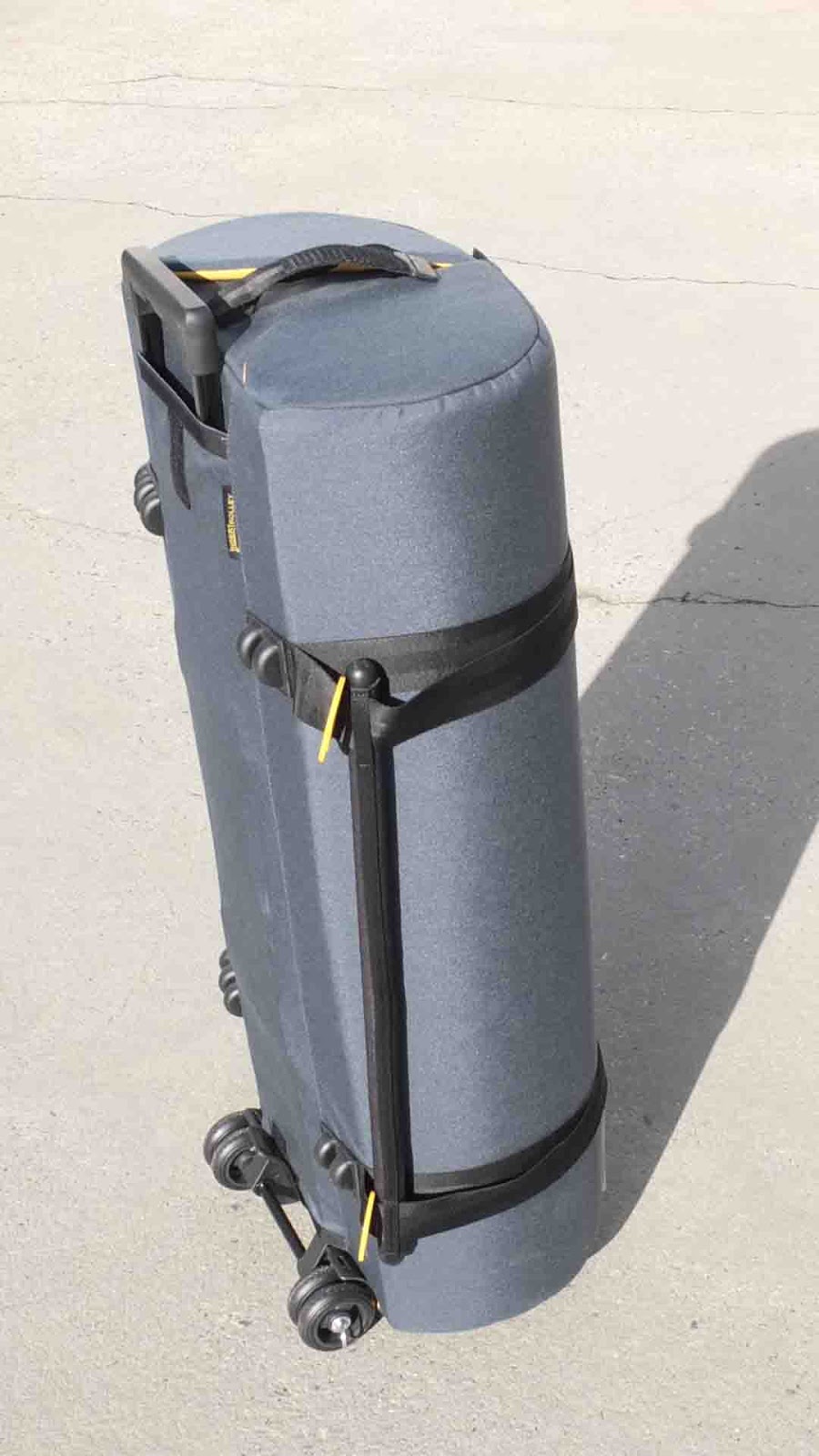
Kata Casket - Studio In The Field


Anyone who has ever tried to carry an entire set of studio monoblock flash units, stands, cords, and light shapers to a shoot outside their own studio knows how difficult it is. Everything has sharp edges, delicate parts, and a mind of its own. You CAN be tripped up and strangled by inanimate objects, particularly if they have discussed it amongst themselves beforehand...


Beat them. Store them safely and securely in the Kata PALMS-2 rolling casket. It will hold three monoblock heads, three stands, folded umbrellas, cords, and reflectors - in short a complete studio light setup. It is padded and armoured on the edges that will hit the ground, and the rolling wheels are extendable to the side for extra satability. Look at the sad pictures - the editorial studio is currently full of people and I have to use the yard... - the casket is a big blue one with the characteristic yellow Kata lining.

If you are a constant user of a field studio, you might elect to replace one of the monoblock heads with a camera and one of the tripod spots with a folding backdrop. Then you can really be portable - everything in one case.


Note that the casket is also big enough to hold earth from your own country if you need somewhere to sleep during the day...

Tuesday, May 28, 2013

Whaddoo I Spend My Mine Money On Now?


If you are currently sitting on an iron ore wallet - and have exhausted all the other possibilities of Western Australian photography; HDR sunsets, trying to make Lesmurdie Falls look like Niagara, Barbagallo Raceway, Thailand, Africa, British Columbia, or Notherdam Gorge, may I suggest you come into Camera Electronic and get something new?

See the attached images - they are of unnatural lights taken in natural light from artificial light sources. Sort of like an Escher etching, but with a camera.


Studio lighting is wonderful. It gives you controllable illumination, multiple artistic effects, and a good reason to spend more of your mining money. You can set up a home studio and capture whatever your heart desires - no trekking, traipsing, or travel. You no longer are restricted to the "magic minute" at sunrise or sunset that the travel writers blurt on about - you can create magic minutes all day long if you like. You can make pictures as saturated or as neutral as you wish. You can MAKE your subjects look good, rather than sitting there waiting an hour in the flies and heat hoping that it will happen.


Hard to do? No. Hard to learn? No. Books are all over out there to help you do whatever lighting you want to do - some of them are just pictures of nudes with a line drawing to show where the lights were supposed to be - some of them are technically-specific lighting recipe books. Suit yourself which ones you take into the loo with you.

You can also get good lighting training next door at Shoot Photography - they run periodic courses in the subject. We have promotional nights every now and then when a good studio photographer shows you what can be done with specific equipment. You can buy a set of lights and the associated studio backdrop stand and just set out on your own journey of discovery - I did and now where the hell am I? No, no - it's all good - I DO know what I am doing, Officer...

With a bit of luck, when the mine shuts down, you can retire to your studio in Perth and make a modest fortune. I did. I made it from a large fortune.

PS: It is also possible to spend mine money on mines, but you'll have to lay the field yourself...

Uncle Dick


Wednesday, May 15, 2013

What Does That Look Like To You?


That flash head up there in the boom arm - is that an Elinchrom?

By golly, yes it is. It's one of the new Elinchrom D-Lite RX One heads. Looks like someone finally made a good system flash head that can go on the end of an arm - 'course you could always put things on the ends of boom arms, but with heavy flashes, the boom arm started to get heavier and the the support stand started to get heavier, and pretty soon you had the sort of thing that Cammel Laird used to put turrets on battleships...

No, the new RX One looks like the go. It seems to throttle down fairly low - 6 W/sec and can go up to 100 W/sec in 1/10 steps. That's enough power to shoot portraits in a small studio no problems - and what a great light source for the light cube style of product work.

Okay, it takes all the standard Elinchrom light shapers and whatever you can invent in addition*. You get a couple of shoot-through umbrellas in the two-head kit and a hard wide reflector. I'd opt for an additional 18cm wide reflector with the recessed rim and a couple of 18cm honeycomb grids. Great face and hair shots. Standard Super-Leuci modelling globes as well.


Looks like it comes equipped in each head for hard wire, infra-red, and radio triggering. They include one of the Skyport transmitters in the package.

Two stands, two travel bags. This is a good deal - about twice the power of the average portable speed light flash and lots of ready-made shapers for that light.

* Students - the best light shapers are made with gaffer tape and matt boards, with the occasional addition of a washed-out baked bean tin. If you have an Elinchrom speed ring you can make a light shaper out of a wheelie bin...

Tuesday, May 14, 2013

Care For A Snoot, Honey?


In the spirit of science here are three studio shots of a bedside lamp modified by Profoto light shaping tools - specifically the honeycomb grids that clip onto standard reflectors and the snoot which does he same.


The 5º grid throws a much smaller circle of light than the 10º grid. They are both somewhat of a soft edge to the light - perfect for highlighting faces in portraits or products on a table.


The snoot also restricts the blast of light but does so with a sharper edge and more artifacts in the light pool.

Note that all of these devices absorb light and radiate it back as heat but the grids are generally buried in the front of the reflectors while the snoot is right out there ready to get you on the forehead as you move through the darkened studio...

If you are a speedlight shooter have a look on the HONL rack in the shop - they also do small versions of the grids that you can velcro on to portable flashes and they have a very neat foldable snoot that does not become hot.

Wednesday, May 1, 2013

Two Chances Only For A Unique Studio Softbox


Starting a studio? Going to try video for the first time? Need a softbox for your speed light?

All good questions that a new studio enthusiast or student might ask themselves - and there are two good answers sitting out on the floor in the CL sale right now - you'll have to be fast because there are ONLY two.


The first is a speed ring that has an integral 1/2" studio stand mount attached to it and a cold-shoe mount for standard portable speed lights at the back. Not a flimsy outfit - this is meant as a demo and display unit and really will last for a century. The speed ring is colour-coded for the CL softboxes, of which we have many and they are all on 50% off sale.


The second is the same speed ring but with a solid mount and an Edison-screw socket mounted ready to take a standard light bulb - or a stronger photo light if you can find one. It would be perfect as a soft fill for video as it will be silent.

Two only - come and get 'em.

Monday, April 29, 2013

Learn To Light With Shoot Workshops


Studio lighting - there's more to it than sawing the roof of the house off, or setting fire to the sitter. As fun as these ideas may be, new studio shooters need to know other forms of illuminating their subjects. Here is where Shoot Photography Workshops and Anthony Wilson come in.

Anthony will be conducting a three-week introduction to studio lighting in May. Hell be lecturing and demonstrating the ins and outs of flashes, light modifiers, exposure rations, posing , shooting, and equipment for a host of studio situations.

If you have just bought a two-flash kit and want to know how to get the best out of it - or if you want to expand your range of illuminations and wish to find out exactly what light shapers do - Anthony is the man to listen to.

The course will be on the 6th of May - the 13th of May - and the 20th of May. It won't be a crowded pie fight either - there will be time and space for individual help  and creativity.

The basic cost for the three-wek course is $ 325 - but if you give the nice person at Shoot a ring in the next little bit, you can claim a 10% discount. Money well spent as you find out how to light your professional jobs.

Please ring the Shoot person at 9228-8232 or go over to their email at:

enquiries@shootworkshops.com.au

Speaking from experience, there is nothing as freeing as having your own shooting studio and the ability to create drama and beauty with light is fabulous. Get that experience now - ring Shoot.

Sunday, April 21, 2013

You Have The Power - With Godox


Today is Earth Day. You all know what that means. Time to have your wall sockets and extension cords checked by a qualified electrical contractor.

While you are thinking electrical, consider the Godox power inverter. We have the LP 800-X model in stock right now and the price has dropped from $ 995 to $ 895.

Do you have studio flashes that are locked into your studio? Or a computer that needs mains power to run? Or  hot lights that need 240VAC to operate? Are you sick of having to unreel 25 kilometres of extension cords from your house to the beach for a location shoot - and then having to reel them back up again to go home?


Here is where the Godox inverter is your frend. There are three standard AC sockets on one side and three USB sockets sockets on the other - see images. The power inverter locks onto the top of the dedicated rechargeable battery and pumps out 750 watts continuous or 800 intermittent power. You can draw off 110VAC 60Hz or 240 V Ac 50Hz. There are overload and short circuit protectors in operation. There is even a low voltage alarm to let you know when it is time to change batteries.


The change-over couldn't be simpler - just unclip four safety locks at the sides of the inverter and lift it off the battery. There are spare batteries available and as it only takes three hours to trickle charge one, you can have a spare ready to go.


This is the type of solution that means you can have studio flash power and effective light shaping wherever you have a location shoot - and you don't have to change over your current equipment.

Current equipment. Earth Day. Ooh, they're coming thick and fast today...

Tuesday, April 9, 2013

Two Heads Are Better Than One - Profoto


Now we're not talking Tasmania or Newfoundland here - this is about the business of getting two portable studio flashes out and about. Specifically the Profoto variety.

The Acute B2 from Profoto is the sort of portable flash generator that you can take out into the filed to provide the power land controllability that pure speedlights cannot do. It is fully integrated with the vast range of Profoto light shapers and has the sort of stopping power for action that sports or advertising people need.

Now it is possible to increase the pattern of lighting with two of the portable heads connected to the generator - Profoto have introduced a split cable for the system. Main and fill. Hatchet lighting. hair and front. Possibilities increase...

Wednesday, March 20, 2013

Big Soft Sale For Big Hard Photographers


Go on. Harden up. Time to soften your photos.

We've just put out a sales stack of CL-brand soft boxes and suitable speed rings on our bargain floor near the front of the store.

The CL boxes come in all sorts of sizes - from little 40 x 40 squares up to massive strip and bed boxes. There are octas as well. Also deep and shallow types and some with recessed fronts so that you can fit egg crate grilles.

The speed rings are available for Elinchrom, Profoto, and Bowens - though there are a limited number of Bowens ones. As you'll see from the illustration, the rings are multiple-use types - they are colour-coded for where the rods are to be inserted.


These are well-built items and would serve a good long time in professional use.

The sale prices are 30% off marked retail for individual items - and if you buy the softboxes with a lighting kit we'll go to 40% off the softbox prices. It is a good opportunity to expand the light-shaping capabilities of your studio.